 Posted by
 In this article, we focus on the most popular recipe ingredients in over 20,000 recipes sampled from Epicurious in 2019.
Data analytics on recipes can be helpful for many reasons.
One is so that we can see trends on what are popular or ‘hot’ food items. Another reason could be for nutrition analytics. Here, we want to help the avid cook optimize their ingredient stockpile for this year’s current recipes.
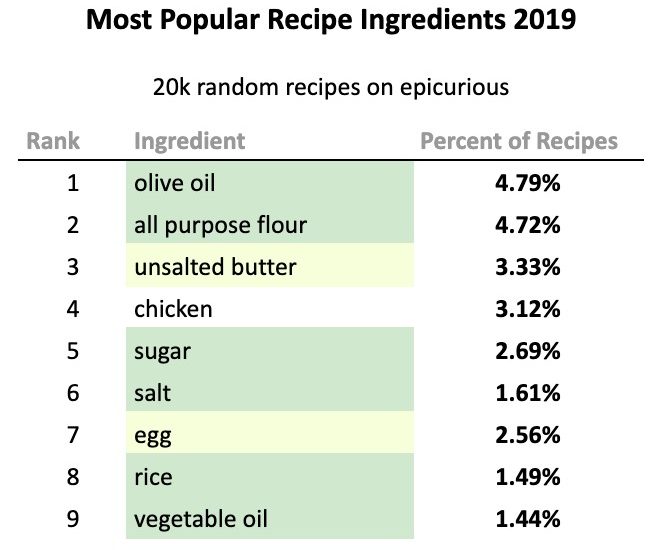
The Top Five Most Popular Ingredients
- Olive oil
- All purpose flour
- Butter
- Chicken
- Sugar
Having a handle on the most popular recipe ingredients can be quite useful in stocking your fridge or pantry. For example, this year, extra virgin olive oil topped the list at just under 5% of all recipes. Compared to canola oil, olive oil has less calories, less fat and an extra helping of iron. As an ingredient with a fairly long shelf live, it would be great to stock up on when there’s a sale in the super market.
Similarly, all purpose flour, who is right on top of its good friend, butter is number two on the list. At just below 5% of all recipes, flour is also non-perishable. Buying it in bulk can help you save time and money next time you have a baking craving or want to thicken up a winter soup.
Chicken, which includes recipes that call for breast, legs or patties, is at number four. Top of the list of animal proteins, it’s also one of the most affordable. Compared to beef, chicken has less calories, less fat and a more balanced profile of essential amino acids.
Unsurprisingly, salt and sugar land the next two spots at five and six. They are staples in seasoning and many dishes as a call for flavor. Sugar comes in a few forms, white, brown, turbinado, etc. Comparing white versus brown sugar, brown sugar is a bit better for you as it contains small amounts of calcium and magnesium.
The Complete List of Most Frequent Ingredients
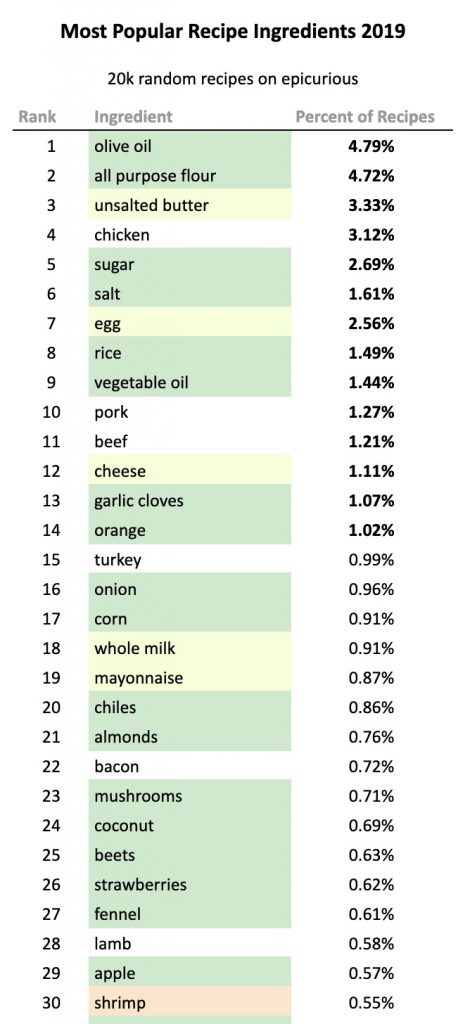
The entire list of our top 30 most popular recipe ingredients is below.
- Olive oil
- All purpose flour
- Butter
- Chicken
- Sugar
- Salt
- Egg
- Rice
- Vegetable oil
- Pork
- Beef
- Cheese
- Garlic
- Orange
- Turkey
- Onion
- Corn
- Whole milk
- Mayonnaise
- Chiles
- Almonds
- Bacon
- Mushrooms
- Coconut
- Beets
- Strawberries
- Fennel
- Lamb
- Apple
- Shrimp
A Word on Ingredient Categories
Notably, 23 or more than three quarters of the ingredients are vegetarian friendly (highlighted in green and yellow). Shrimp, a pescatarian favorite, takes the 30th spot.
18, or 60% of the ingredients are vegan which means the majority of top 30 ingredients is vegan-friendly. This is an ongoing trend. As one example, almonds outranked bacon in terms of popularity in recipes in 2019.
Analysis Details
This analysis was completed through a sampled dataset of Epicurious recipes in 2019. We merged similar ingredient through automated text analysis. For example, extra-virgin olive oil is merged with its parent group, olive oil.
Further analysis on the ingredient best friends will follow this post.
On-chain yield generation. On-chain yield generation has become a popular trend in the world of cryptocurrency and decentralized finance. This innovative concept allows users to earn passive income by providing liquidity to decentralized exchanges or by staking their assets in various protocols. One of the main advantages of on-chain yield generation is the ability to earn a high return on investment without the need for a centralized intermediary. This means that users mysticfinance have full control over their funds and can participate in the network without having to trust a third party. This level of transparency and security is a key reason why many people are attracted to on-chain yield generation. There are several ways in which users can generate yield on-chain. One common method is through liquidity mining, where users provide liquidity to decentralized exchanges in exchange for rewards in the form of tokens. By contributing their assets to a liquidity pool, users help facilitate trading on the platform and are rewarded with a share of the trading fees. Another popular method of on-chain yield generation is staking. Staking involves locking up a certain amount of cryptocurrency in a network protocol in order to support the network’s operations and earn rewards. Users who stake their assets are often rewarded with additional tokens or a percentage of the transaction fees generated by the network. On-chain yield generation has the potential to revolutionize the traditional financial system by providing users with new ways to earn passive income and participate in decentralized networks. By removing the need for intermediaries and enabling users to directly interact with smart contracts, on-chain yield generation opens up a world of possibilities for investors and traders. However, it’s important to note that on-chain yield generation also comes with risks. The decentralized nature of these protocols means that they are vulnerable to smart contract bugs, hacking attacks, and other security threats. Users should conduct thorough research and due diligence before participating in on-chain yield generation to minimize their exposure to risk. Despite these challenges, on-chain yield generation has the potential to democratize finance and empower individuals to take control of their financial futures. By providing users with the opportunity to earn passive income and participate in decentralized networks, on-chain yield generation is paving the way for a more inclusive and transparent financial system. In conclusion, on-chain yield generation is an exciting development in the world of cryptocurrency and decentralized finance. By enabling users to earn passive income and participate in decentralized networks, on-chain yield generation has the potential to revolutionize the traditional financial system. While there are risks involved, the benefits of on-chain yield generation are clear, and many investors are eager to explore this innovative way of generating yield in the digital age.