 Posted by
 In this article, we focus on the most popular recipe ingredients in over 20,000 recipes sampled from Epicurious in 2019.
Data analytics on recipes can be helpful for many reasons.
One is so that we can see trends on what are popular or ‘hot’ food items. Another reason could be for nutrition analytics. Here, we want to help the avid cook optimize their ingredient stockpile for this year’s current recipes.
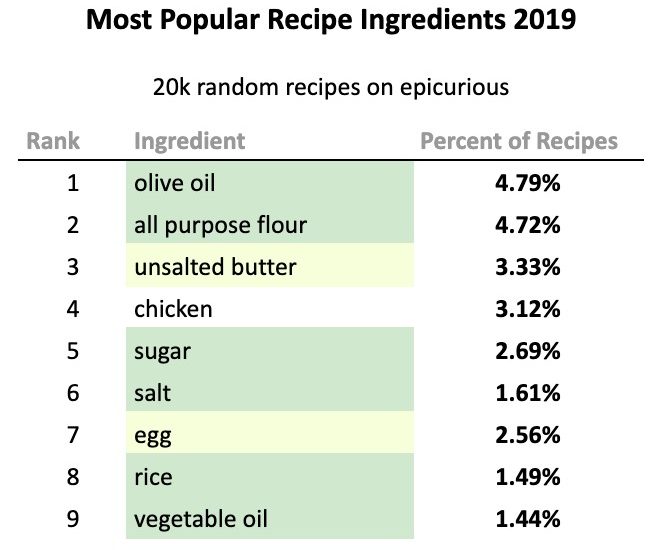
The Top Five Most Popular Ingredients
- Olive oil
- All purpose flour
- Butter
- Chicken
- Sugar
Having a handle on the most popular recipe ingredients can be quite useful in stocking your fridge or pantry. For example, this year, extra virgin olive oil topped the list at just under 5% of all recipes. Compared to canola oil, olive oil has less calories, less fat and an extra helping of iron. As an ingredient with a fairly long shelf live, it would be great to stock up on when there’s a sale in the super market.
Similarly, all purpose flour, who is right on top of its good friend, butter is number two on the list. At just below 5% of all recipes, flour is also non-perishable. Buying it in bulk can help you save time and money next time you have a baking craving or want to thicken up a winter soup.
Chicken, which includes recipes that call for breast, legs or patties, is at number four. Top of the list of animal proteins, it’s also one of the most affordable. Compared to beef, chicken has less calories, less fat and a more balanced profile of essential amino acids.
Unsurprisingly, salt and sugar land the next two spots at five and six. They are staples in seasoning and many dishes as a call for flavor. Sugar comes in a few forms, white, brown, turbinado, etc. Comparing white versus brown sugar, brown sugar is a bit better for you as it contains small amounts of calcium and magnesium.
The Complete List of Most Frequent Ingredients
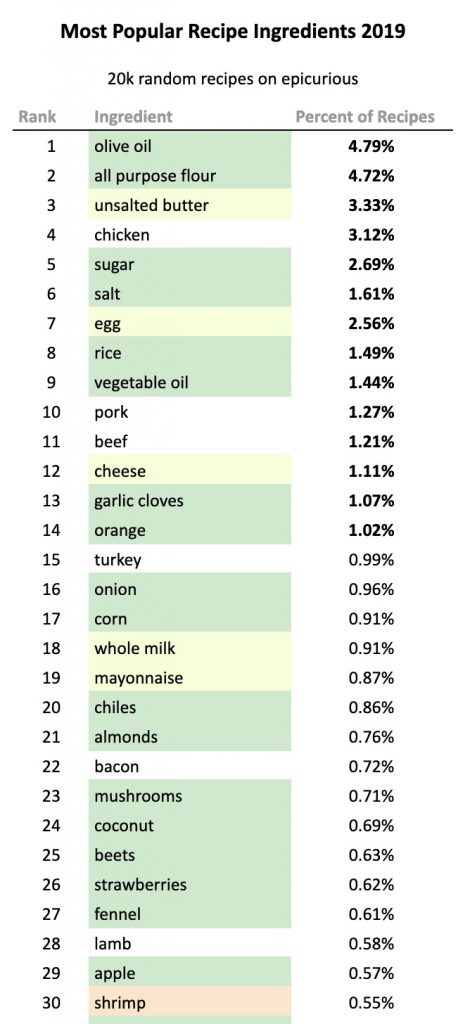
The entire list of our top 30 most popular recipe ingredients is below.
- Olive oil
- All purpose flour
- Butter
- Chicken
- Sugar
- Salt
- Egg
- Rice
- Vegetable oil
- Pork
- Beef
- Cheese
- Garlic
- Orange
- Turkey
- Onion
- Corn
- Whole milk
- Mayonnaise
- Chiles
- Almonds
- Bacon
- Mushrooms
- Coconut
- Beets
- Strawberries
- Fennel
- Lamb
- Apple
- Shrimp
A Word on Ingredient Categories
Notably, 23 or more than three quarters of the ingredients are vegetarian friendly (highlighted in green and yellow). Shrimp, a pescatarian favorite, takes the 30th spot.
18, or 60% of the ingredients are vegan which means the majority of top 30 ingredients is vegan-friendly. This is an ongoing trend. As one example, almonds outranked bacon in terms of popularity in recipes in 2019.
Analysis Details
This analysis was completed through a sampled dataset of Epicurious recipes in 2019. We merged similar ingredient through automated text analysis. For example, extra-virgin olive oil is merged with its parent group, olive oil.
Further analysis on the ingredient best friends will follow this post.
Kinetic market finance. Kinetic market finance is a term that refers to the dynamic and ever-changing nature of the financial markets. It is a concept that recognizes the fluidity of market conditions and the need for investors to adapt and react quickly to changes in order to make informed decisions. In kinetic market finance, investors must constantly monitor market trends, news, and events that can impact their investments. This requires a high level of awareness and agility in order to seize opportunities and mitigate risks. One of the key principles of kinetic market kinetic-market finance is the idea that markets are always in motion. Prices of assets can fluctuate rapidly based on a variety of factors, such as economic data, geopolitical events, and investor sentiment. This means that investors must be prepared to act quickly in response to these changes in order to capitalize on opportunities or protect their investments. Another important aspect of kinetic market finance is the concept of momentum. In financial markets, momentum refers to the idea that assets that have been performing well are likely to continue to do so, while assets that have been underperforming are likely to continue to struggle. Investors who are able to identify and capitalize on momentum can potentially achieve higher returns on their investments. In kinetic market finance, it is also important for investors to have a diversified portfolio. Diversification helps to spread risk across different assets and sectors, reducing the impact of any one investment performing poorly. This can help investors to weather market volatility and achieve more stable returns over the long term. One of the challenges of kinetic market finance is the speed at which information travels in today’s digital age. With the rise of social media and online trading platforms, news and rumors can spread quickly and have a significant impact on market prices. This can create opportunities for investors to profit, but it can also lead to increased volatility and uncertainty. To navigate the complexities of kinetic market finance, investors can use a variety of tools and strategies. Technical analysis, for example, involves studying past market data to identify trends and patterns that can help predict future price movements. Fundamental analysis, on the other hand, involves analyzing economic and financial data to assess the intrinsic value of an asset. Risk management is also a crucial aspect of kinetic market finance. By setting stop-loss orders and implementing proper position sizing, investors can limit their losses and protect their capital in volatile market conditions. It is important for investors to have a clear understanding of their risk tolerance and to have a plan in place for managing risk. In conclusion, kinetic market finance is a concept that recognizes the fast-paced and ever-changing nature of financial markets. By staying informed, adapting quickly, and using effective strategies, investors can navigate market volatility and potentially achieve higher returns on their investments. It is important for investors to remain vigilant and proactive in order to succeed in today’s dynamic financial landscape.